WireGuard VPN is a modern VPN protocol that encrypts your internet traffic and secures the connection between devices. It creates a private, encrypted tunnel, making it harder for anyone to intercept or monitor your data.
Unlike older protocols, WireGuard is built on a minimal codebase and uses state-of-the-art cryptography. This makes it faster to connect, easier to configure, and less prone to security vulnerabilities.
Whether you’re setting up a VPN for remote access, cloud integration, or private browsing, WireGuard offers a lightweight and high-performance option that works across platforms.
How Does WireGuard Work?
WireGuard VPN creates a direct, encrypted tunnel between your device and a VPN server. Similar to SSH, it uses public and private keys for authentication. Once devices exchange and verify keys, a secure connection is formed, allowing data to flow privately across the network.
What sets WireGuard apart is how it handles this connection. Instead of using complex negotiation steps or bloated libraries, it keeps things lean. It only allows packets from recognized peers, based on their public key and assigned IPs, making the tunnel secure.
WireGuard runs inside the system’s network layer (kernel or equivalent), which means it processes traffic faster and more efficiently than many traditional VPNs. It’s designed to reconnect quickly if the connection drops, which helps maintain stability for remote users or distributed teams.
In simple terms, WireGuard securely connects devices using a lightweight, key-based handshake system and routes traffic through an encrypted tunnel with minimal overhead.
What Protocols Does WireGuard Use?
WireGuard doesn’t rely on legacy protocols or support dozens of options. Instead, it’s built around a small, focused set of modern cryptographic primitives that are fast, secure, and easier to maintain. It uses:
ChaCha20 for encryption
Poly1305 for authentication
Curve25519 for key exchange
BLAKE2s for hashing
SipHash24 and HKDF for internal handling
By default, WireGuard runs over UDP, not TCP. This design choice allows for faster transmission, lower latency, and better performance in real-time applications, especially across inconsistent or mobile networks.
By limiting itself to secure-by-default primitives and using only UDP, WireGuard avoids the overhead and complexity that can come with older protocols or configurable stacks. It’s designed to offer strong protection with minimal configuration.
WireGuard Use Cases
If you're planning to adopt WireGuard, it’s important to understand where it fits best. Its speed, simplicity, and modern cryptography make it useful in many real-world scenarios:
Secure remote access for teams: You can use WireGuard to give employees encrypted access to company networks, whether they work remotely or across multiple office locations.
VPN deployment on cloud or virtual servers: Its minimal setup makes it ideal for hosting business VPN servers on cloud platforms or VPS environments without complex configuration.
Linking distributed cloud infrastructure: WireGuard can securely connect cloud services, databases, or containers across regions, protecting internal traffic.
Use on routers, firewalls, and IoT devices: Its lightweight codebase allows it to run efficiently on embedded systems where resource usage matters.
Device access control in BYOD setups: Businesses can integrate WireGuard with access control policies to restrict or segment access across personal and unmanaged devices.
Streamlined developer access: IT teams and developers can use WireGuard to connect to code repositories, APIs, or internal tools while working across multiple environments.
Persistent site-to-site or automated VPNs: WireGuard performance makes them a solid choice for always-on VPN tunnels that require minimal manual intervention.
For individuals, WireGuard also works well for private browsing, bypassing local restrictions, and securing public Wi-Fi. It is a great choice for those looking for a fast, low-maintenance VPN setup.
Pros and Cons of WireGuard VPN
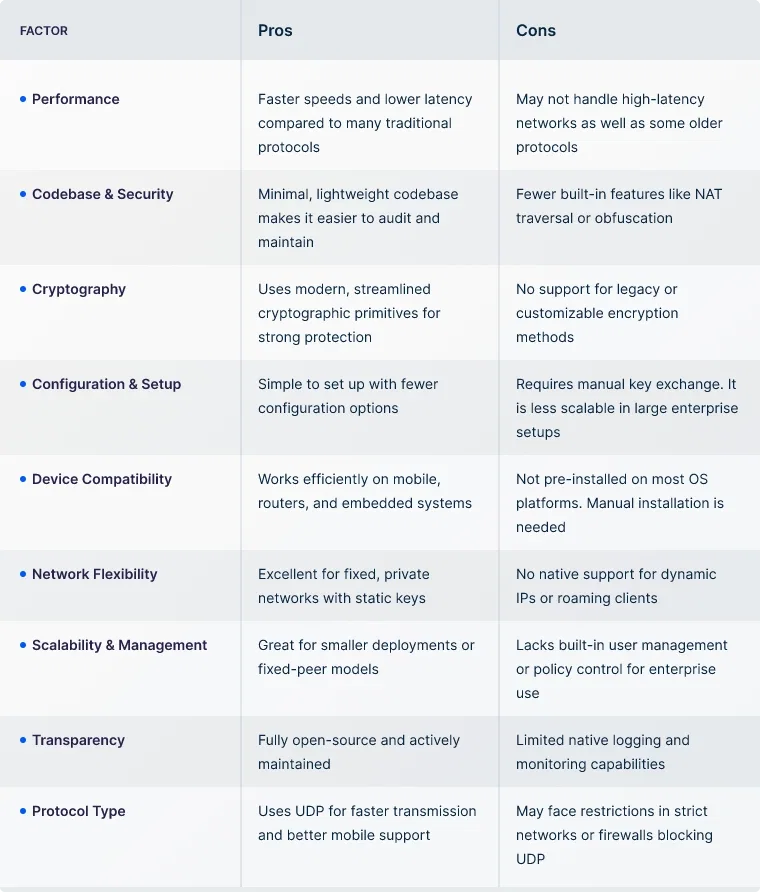
Learning where WireGuard VPN can be used is important, but that alone doesn’t give the full picture. To decide if it's the right fit for your network, it helps to weigh the benefits and trade-offs. Here's a quick comparison:
WireGuard vs Other VPN Protocols
While WireGuard VPN is a strong choice for both individuals and businesses, you might want to compare it with other protocols before making a decision. Doing so helps you understand how each stacks up against WireGuard VPN.
WireGuard vs OpenVPN
Codebase: WireGuard has around 4,000 lines of code, while OpenVPN has over 100,000. This makes WireGuard easier to audit and less prone to bugs.
Speed: WireGuard generally outperforms OpenVPN in terms of throughput and latency, especially on mobile or low-power devices.
Security: Both are secure, but WireGuard uses a fixed set of modern cryptographic protocols, while OpenVPN offers more customizable encryption options.
Compatibility: OpenVPN works out of the box on most systems and has mature third-party support. WireGuard needs manual installation on some platforms.
Use Case Fit: Choose WireGuard for speed and simplicity. Choose OpenVPN if you need fine-tuned encryption or wider device compatibility.
WireGuard vs IKEv2/IPSec
Mobility: IKEv2/IPSec supports seamless connection switching, making it ideal for mobile users on the move. WireGuard does not handle roaming as well.
Performance: WireGuard is usually faster and more efficient, especially on newer hardware.
Configuration: WireGuard is simpler to set up. IKEv2/IPSec can require more complex configurations, especially with certificate handling.
Security: Both are considered secure. WireGuard uses newer encryption primitives, while IKEv2/IPSec has been around longer with wide industry support.
Use Case Fit: Choose IKEv2/IPSec for mobile-heavy deployments and strong interoperability. Choose WireGuard for modern infrastructure and performance-focused use.
WireGuard vs PPTP
Security: WireGuard is exponentially more secure. PPTP is outdated and no longer recommended for secure communication.
Speed: PPTP can be fast, but at the cost of weak encryption. WireGuard offers both speed and strong security.
Compatibility: PPTP is widely supported but blocked by many networks. WireGuard works on modern systems and is being adopted rapidly.
Use Case Fit: Avoid PPTP for any serious use. WireGuard is the better choice in every way.
WireGuard vs L2TP/IPSec
Setup: L2TP/IPSec often requires manual configuration and shared secrets. WireGuard uses public keys and is simpler to manage.
Security: WireGuard is considered more secure with its modern cryptography. L2TP/IPSec has known weaknesses and overhead due to double encapsulation.
Performance: WireGuard is faster due to its minimal design and efficient handling of packets.
Use Case Fit: Use L2TP/IPSec only when legacy compatibility is needed. WireGuard is preferred for most modern business use cases.
UTunnel WireGuard VPN: Built for Secure, Scalable Connectivity
UTunnel delivers full WireGuard support through its MeshConnect solution. It's a reliable way to build secure, high-performance VPN tunnels across cloud, on-premise, or hybrid environments. It's designed for businesses looking to simplify remote access while maintaining strong control over who accesses what.
Key Capabilities:
WireGuard-Powered Mesh Networking: Use WireGuard to create encrypted mesh tunnels between remote offices, VPCs, servers, or IoT sites for fast and efficient connectivity.
Zero Trust Network Access (ZTNA): Enforce policy-based access control so users only reach the specific resources they’re authorized to, not the full network.
Multi-Site and Remote Access Support: Connect distributed networks or enable secure remote access. Everything is configurable from a centralized web dashboard.
Dynamic and Static IP Compatibility: It works with both dynamic and static IPs, depending on your business needs and allow listing requirements.
Split Routing and Custom Port Support: Route only selected traffic through the VPN tunnel and configure WireGuard on ports that suit your firewall or ISP setup.
Cross-Platform Client Support: MeshConnect’s user-friendly app is available for all major operating systems and helps manage user access across networks.
Quick Setup with Central Management: Get started in minutes. Add sites, define access policies, register MeshConnect agents, and manage everything from one place.
WireGuard VPN FAQs
Is WireGuard safe to use?
Yes, WireGuard is secure and trusted by developers and security experts. It uses modern cryptography like ChaCha20 and has a very small codebase, which makes it easier to audit and less prone to exploits.
What port does WireGuard use?
By default, it uses UDP port 51820, but you can change this based on firewall settings or network rules. Custom ports help it bypass certain restrictions in enterprise environments.
Is WireGuard TCP or UDP?
WireGuard only works over UDP, which is lighter and faster than TCP. This improves performance and makes it ideal for real-time use cases like VoIP and remote access.
Can WireGuard hide your IP address?
Yes. When connected, it replaces your device’s IP with that of the VPN server. This helps anonymize traffic and keeps your browsing activity private from external observers.
Is WireGuard a full tunnel or a split tunnel?
It supports both. You can route all traffic through the tunnel (full tunnel) or only route specific IPs or domains (split tunnel). This makes it flexible for businesses that need both global and local access.