

MeshConnect for IoT Apps: Simplify Remot…
Are you still relying on standard setups to keep your IoT applicatio…
 October 07, 2025
Wondering if UTunnel is GDPR compliant or how it fits into your compliance strategy? UTunnel is designed to support GDPR compliance by giving businesses control over how data is accessed, transmitted, and audited.
This control is essential for SMBs that handle sensitive information or operate in the EU. This article explains how UTunnel aligns with key GDPR requirements and how small and mid-sized businesses use it to strengthen their compliance posture.
If you want to learn how UTunnel aligns with GDPR, you must first understand why compliance is essential for small and mid-sized businesses.
The General Data Protection Regulation (GDPR) sets strict rules on how personal data of EU residents is collected, accessed, and processed. It applies to any organization, regardless of size, that handles this data. Here’s why compliance matters for SMBs:
Small businesses are not exempt from GDPR. The regulation applies if you collect names, emails, or other personal information from EU residents, even through a contact form or support request.
This includes situations where data is handled regularly, contains sensitive information, or could impact individual rights. Many SMBs, especially in sectors like SaaS, healthcare, and financial services, fall into this category. If your business processes personal data from the EU, GDPR is a legal obligation regardless of company size or location.
Customers want to know what data you collect, why you need it, and how it’s being used. This expectation applies whether you’re a global enterprise or a five-person team. GDPR reflects this shift in user awareness. It gives individuals clear rights over their personal data, including access, correction, and deletion.
For small businesses, this means building processes that allow customers to make those requests easily and receive timely responses. Ignoring these expectations can damage trust, even if no legal action follows. On the other hand, businesses that are transparent about data use often gain credibility and customer loyalty.
Non-compliance with GDPR can lead to more than just fines. Regulators have the authority to restrict or suspend a company’s ability to process personal data. For a small business, that can mean delays in customer onboarding, lost contracts, or interrupted service delivery.
Even minor incidents, like misconfigured access or missing consent records, can trigger investigations. Fines can reach up to 4% of annual revenue or €20 million, whichever is higher. But for SMBs, the real cost often comes from legal time, damaged reputation, and operational slowdowns.
Many SMBs fail GDPR not because of intent but because of weak security practices. Missing encryption, shared credentials, lack of access control, or incomplete logging are some of the most common gaps.
GDPR expects businesses to implement technical and organizational measures that protect data throughout its lifecycle. Without structured controls, even a small error, such as unauthorized access or a lost device, can qualify as a reportable breach.
Customers, partners, and vendors all want to work with businesses that handle data responsibly. GDPR compliance signals that your company takes privacy seriously, which builds confidence in your services.
For SMBs, this trust can lead to better customer retention, easier vendor onboarding, and eligibility for contracts that require strict data practices. This not only reduces risk but also creates a foundation for long-term growth.
Many small businesses hesitate because they expect high costs or think they’re too small to be noticed by regulators. If you're weighing whether GDPR compliance is worth the investment, this comparison will ease your doubts.
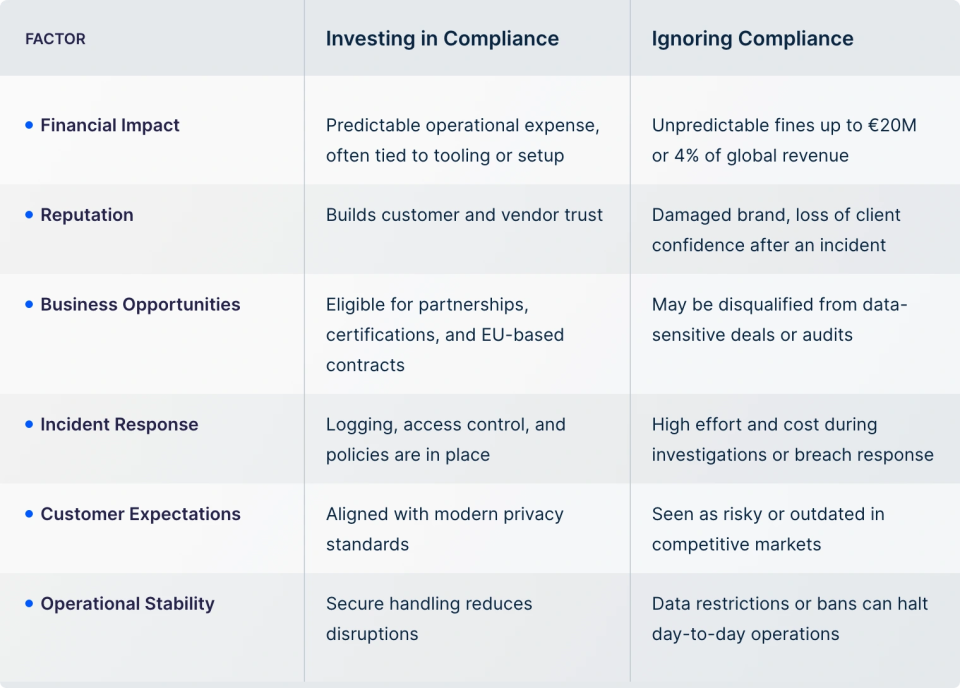
We don’t just claim GDPR compliance, we’ve built our product and privacy policy around it. From how we collect data to how it’s stored, encrypted, and processed, every decision is made with privacy in mind. Here’s how we meet key GDPR standards:
Now that you know how UTunnel achieves GDPR compliance, the next question is how it fits into your day-to-day operations. Here are practical use cases showing how small and mid-sized businesses use UTunnel to protect personal data and meet regulatory expectations:
GDPR compliance needs the right tools beyond policies. UTunnel gives SMBs control over access, data flow, and user accountability, all mapped to core GDPR requirements.
If you're reviewing your compliance setup, this is a good time to explore how UTunnel fits in. You can start a free trial or book a quick demo. As a good practice, regularly review user access, provisioning rules, and activity logs to stay audit-ready.
Yes. Even basic details like names, emails, or IP addresses fall under GDPR if they belong to EU residents. Compliance applies even if you're not storing sensitive health or financial data.
If users access systems without audit logs, device restrictions, or access policies, that’s a red flag. GDPR requires demonstrable controls, not just trust-based access.
Not entirely. UTunnel helps you enforce secure access, manage user provisioning, and log activity. But GDPR also expects internal policies, consent handling, and breach notification workflows.
That depends on your data flow. UTunnel’s access controls, logging, and provisioning features cover most basic GDPR needs. However, external tools may still be needed for advanced use cases.
Yes. UTunnel logs metadata (who accessed what and when), not actual user content. Thus, you can stay accountable without risking exposure to personal data.
Start with the 14-day free trial. Test policy-based access, device control, and logs. For deeper insights, schedule a demo tailored to your compliance goals.
Are you still relying on standard setups to keep your IoT applicatio…
October 07, 2025
Thinking that cyberattacks are only aimed at big businesses? You’ve …
August 22, 2025
Are standard firewalls and other conventional methods not working ou…
July 14, 2025
