

What is SCIM (System for Cross-domain Id…
SCIM is a standard that helps you automate user account creation, up…
 July 04, 2025
A managed VPN service is a subscription-based service where a third-party provider handles the setup, configuration, maintenance, and monitoring of your Virtual Private Network (VPN). Instead of your in-house IT team managing the complexities of a VPN infrastructure, you essentially outsource this task to experts.
These services are designed for fast deployment, strong encryption, flexible scaling, and high reliability. It's ideal for organizations that need secure network access without added complexity.
With a managed VPN service in place, your remote teams connect securely to your private network using pre-configured VPN clients on desktops, laptops, or mobile devices. Once authenticated, the client establishes an encrypted tunnel through the provider’s infrastructure, giving users seamless access to internal systems, files, and applications as if they were on-site.
What sets a managed VPN apart is what happens behind the scenes. The provider handles all aspects of VPN operation, including infrastructure provisioning, traffic monitoring, policy enforcement, security patching, and performance optimization. They ensure your VPN stays updated, available, and secure, without requiring constant oversight from your internal IT team.
In short, it’s secure remote access with expert management built in - so your organization can stay focused on productivity, not network maintenance.
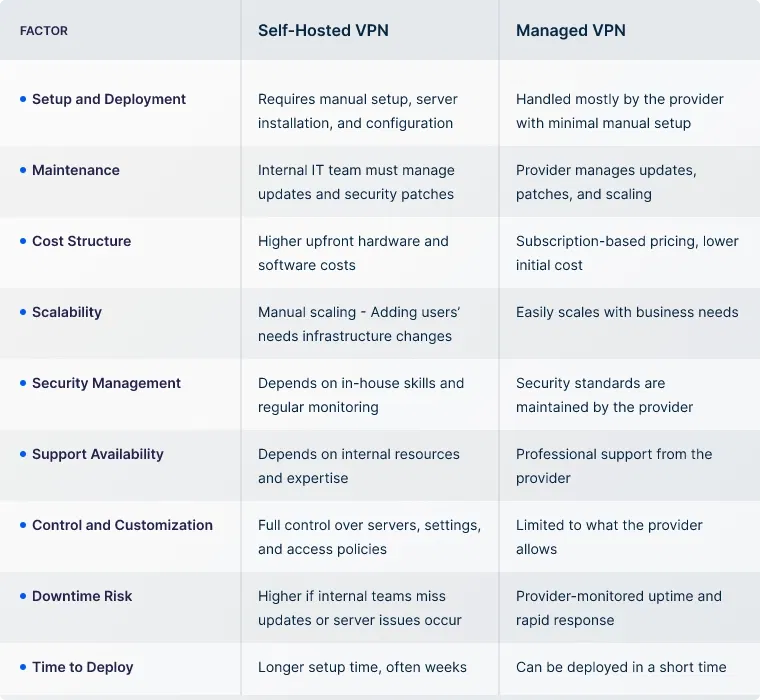
Choosing between a self-hosted VPN and a managed VPN service can be difficult. Whether you need to connect remote teams, secure private resources, or control network access, it is important to pick one that fits your business needs.
Here's a quick breakdown of both so you can make an informed decision.
Businesses across industries need secure, flexible, and easy ways to connect teams, systems, and resources. A Managed VPN Service offers a practical solution by combining strong security with simple management. Here’s how it supports real-world business needs:
With more teams working outside the office, remote access is no longer optional. A Managed VPN Service allows employees to connect securely to internal systems from any location. The provider handles the VPN setup, security updates, and monitoring. This means businesses can quickly onboard remote employees without setting up complex hardware or risking unsafe connections.
Connecting multiple office locations traditionally required expensive private circuits. A simpler and cost-effective alternative is a managed VPN. Branch offices can connect to headquarters over a secure tunnel, without building a dedicated network. It reduces costs, speeds up expansion, and keeps all locations securely linked.
Many businesses now depend on cloud services for daily operations. A managed VPN Service protects the traffic between users and cloud apps, adding an extra layer of security. It prevents data leaks when accessing sensitive platforms like CRM systems, financial tools, or internal databases hosted in the cloud.
Unexpected disruptions like power outages, office closures, or natural disasters can interrupt access to critical systems. With managed VPN, users can connect to essential resources even when they can't reach the office. It supports disaster recovery plans by ensuring employees have a secure way to work from anywhere.
External vendors and contractors often need secure, short-term access to internal resources. Some managed VPN services include browser-based, agentless access and integrate with access control tools to enforce user-specific permissions. This ensures third parties connect only to designated systems, reducing risk without adding complexity.
Industries like finance, healthcare, and legal services often have strict data protection requirements. Managed VPNs help meet these standards by enforcing strong encryption, access control, and secure communication. Providers also manage regular updates and patches, helping businesses maintain compliance without heavy internal workloads.
Managed VPNs can be deployed quickly, often within minutes, without complex hardware setups. They also allow businesses to scale access up or down based on user needs, supporting growing teams and new locations without heavy reconfiguration.
Professional monitoring, automated updates, and global server infrastructure reduce the chances of service interruptions. Managed VPNs help maintain network reliability and business continuity with less internal effort.
UTunnel offers a cloud-native Managed VPN Service that combines simplicity, strong security, and flexible deployment options for businesses.
UTunnel’s Managed VPN Service helps businesses secure remote access, simplify VPN management, and maintain flexibility as their needs evolve.
A managed VPN service is a ready-to-use solution where the provider handles all setup, maintenance, and monitoring. A regular VPN usually requires businesses to build and manage their own servers. Managed VPNs save time, reduce technical workload, and offer professional support.
A managed VPN helps businesses provide secure remote access, connect multiple locations, and protect sensitive data without needing a large IT team. It also offers faster deployment, easy scaling, and ongoing monitoring, which reduces downtime and operational risk.
Look for strong encryption (like AES-256), support for two-factor authentication (2FA) and Single Sign-On (SSO), a simple management dashboard, server location flexibility, uptime reliability, and compliance with industry standards such as SOC 2 or ISO 27001.
Managed VPN services are ideal for small and medium businesses that need secure remote access for employees, want to connect branch offices, or need to support a remote-first workforce without building complex VPN infrastructure themselves.
It can be. A managed VPN service often provides regular security updates, professional server monitoring, and high-grade encryption without relying on internal IT resources especially for small and medium companies. However, if a business has a strong in-house IT and security team, a self-hosted VPN can be equally secure with proper management.

SCIM is a standard that helps you automate user account creation, up…
July 04, 2025
Zero Trust Access (ZTA) is a security model that limits access to sp…
July 04, 2025
A cloud firewall is a security solution that helps filter and monito…
June 12, 2025
